De Bange 80 mm cannon
The De Bange 80mm cannon (Mle 1877) was a type of field artillery piece.
| De Bange 80mm Mle 1877 "Canon de campagne de 80 modèle 1877" | |
|---|---|
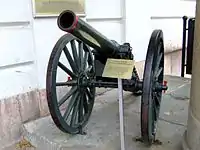 The gun in the Museum of Military History, Budapest | |
| Type | Breechloading cannon |
| Place of origin | France |
| Service history | |
| In service | 1877- |
| Production history | |
| Designer | Charles Ragon de Bange |
| Designed | 1877 |
| Manufacturer | Puteaux |
| Produced | 1879 |
| Specifications | |
| Mass | 423 kg |
| Length | 2.28 m |
| Shell | 4.9 kg explosive shell |
| Caliber | 80 mm |
| Barrels | 1, steel |
| Rate of fire | N/A |
| Sights | unknown |
History
It developed in France by Colonel Charles Ragon de Bange in 1877,[1] and adopted by the French Army that same year. It superseded the earlier Reffye cannon (1870) and the Lahitolle 95mm cannon (1875). De Bange also manufactured another cannon of a rather similar size: the De Bange 90mm cannon.
The cannon was breech loading and used the original mushroom-shaped obturator system developed by de Bange, allowing to properly seal the breech during each firing.[2] The cannon still had an important recoil, meaning that it moved backward at each firing, necessitating re-aiming every time, which considerably slowed the rate of firing. This would remain a problem with all artillery pieces until the development of the recoilless Canon de 75 in 1897.
- Details of components
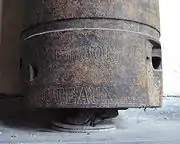 De Bange 80mm Mle 1877 breech portion.
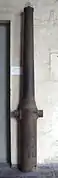 De Bange 80mm Mle 1877, at the Musée de l'Armée, Paris
See also
 Media related to De Bange 80mm cannon at Wikimedia Commons
Notes
 French weapons of the 19th century French weapons of the 19th century | ||
|---|---|---|
| Small arms | ||
| Machine guns | ||
| Cannons | ||
| Warships | ||
| Ammunition |
| |
| Systems | ||
| Operational usage | ||


