Sinkankasite
Sinkankasite, mineral formula: H
2MnAl(PO
4)
2(OH)·6H
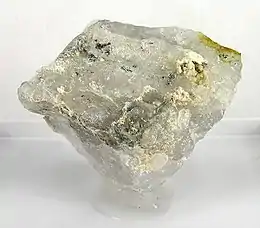
2O, was named after John Sinkankas (1915–2002), noted author and mineral collector, Scripps Institute of Oceanography.[3] It is triclinic; as colorless, bladed to prismatic crystals up to 4 mm in length, often as divergent, radial aggregates and as pseudomorphs after triphlyte crystals; occurs in the Barker pegmatite (formerly Ferguson pegmatite), east of Keystone, South Dakota, and in the Palermo pegmatite, North Groton, New Hampshire.[4]
| Sinkankasite | |
|---|---|
 | |
| General | |
| Category | Phosphate mineral |
| Formula (repeating unit) | H 2MnAl(PO 4) 2(OH)·6H 2O |
| Strunz classification | 8.DB.20 |
| Crystal system | Triclinic |
| Crystal class | Pinacoidal (1) (same H-M symbol) |
| Space group | P1 |
| Identification | |
| Color | Colorless |
| Mohs scale hardness | 4 |
| Luster | Vitreous |
| Diaphaneity | Transparent |
| References | [1][2] |
References
- Mineralienatlas
- Mindat
- Burns P C, Hawthorne F C. 1995. "Sinkankasite." American Mineralogist, 80 (1995) p.620-627.
- Mitchelll, Richard S. 1986. "Who's Who in Mineral Names; John Sinkankas." Rocks and Minerals. Volume 61 (1), page 28.
This article is issued from Wikipedia. The text is licensed under Creative Commons - Attribution - Sharealike. Additional terms may apply for the media files.